

In production, robots take on tasks that demand high availability, precision and repeatability, or that take place in environments unsuitable for people. Eberle implements robot solutions ranging from palletising and bin picking to robots working alongside people.
When a robot pays off
Heavy work
The robot lifts and stacks, relieving your employees.
Precision
Same movement, same quality, with high repeatability.
Availability
The system runs reliably and for long periods without intervention.
Difficult environments
The robot works where conditions are unreasonable for people.
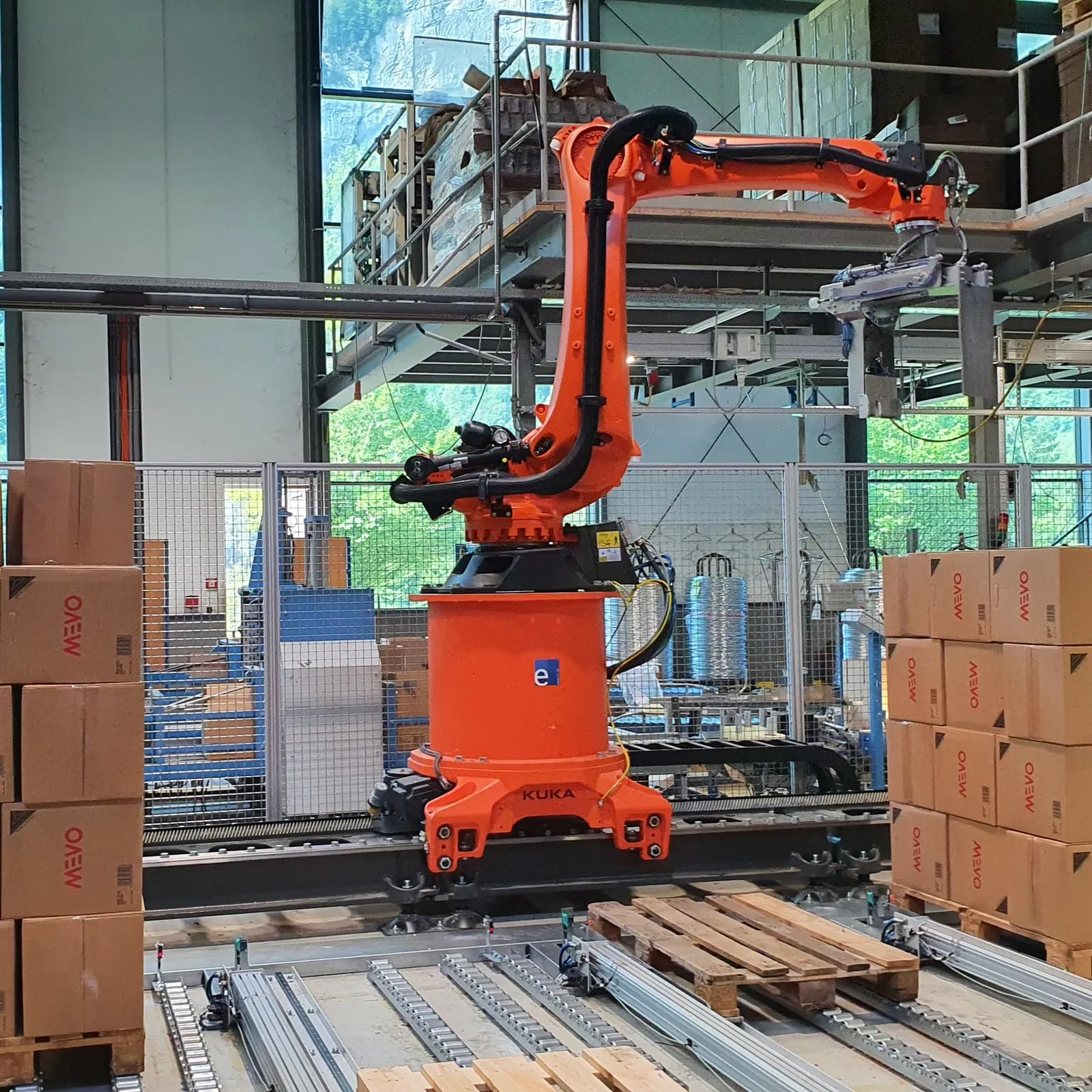
Robot palletising
A palletising robot automatically stacks cartons, crates and other containers onto pallets or takes them off, including across several infeed lines or palletising stations.
- An integrated barcode scanner clearly identifies pallets and goods.
- Empty pallets and interlayers are handled automatically.
- Universal, magnetic or carton grippers, depending on the goods.
Example: complete palletising cell
| Feature | Value |
|---|---|
| Output | up to 10 cycles per minute, depending on carton and palletising pattern |
| Carton size (L × W × H) | 300 × 200 × 80 mm to 300 × 400 × 300 mm |
| Carton weight | 1 to 20 kg |
| Stacking height | up to 1,600 mm |
| Carton types and palletising patterns | 3 each |
| Space requirement | approx. 3 × 3 × 3 m |
The cell includes a palletising robot with base and carton gripper, a centring stop for Euro pallets, safety fencing with safety door, an interface to the on-site carton conveyor system, a control cabinet with touchscreen and a stacking control computer with parameter and alarm management and manual mode. The cell can be fully integrated into existing pallet and carton conveyor systems.
In practice: palletising at Rupp Food
At Rupp Food in Hörbranz, a producer of food and pet food, a palletising robot by Eberle stacks 14 cartons per minute onto Euro pallets, with an interlayer where needed. This relieves employees of heavy lifting. They only remove the full pallets with a pallet truck and make sure there is a supply of empty pallets.
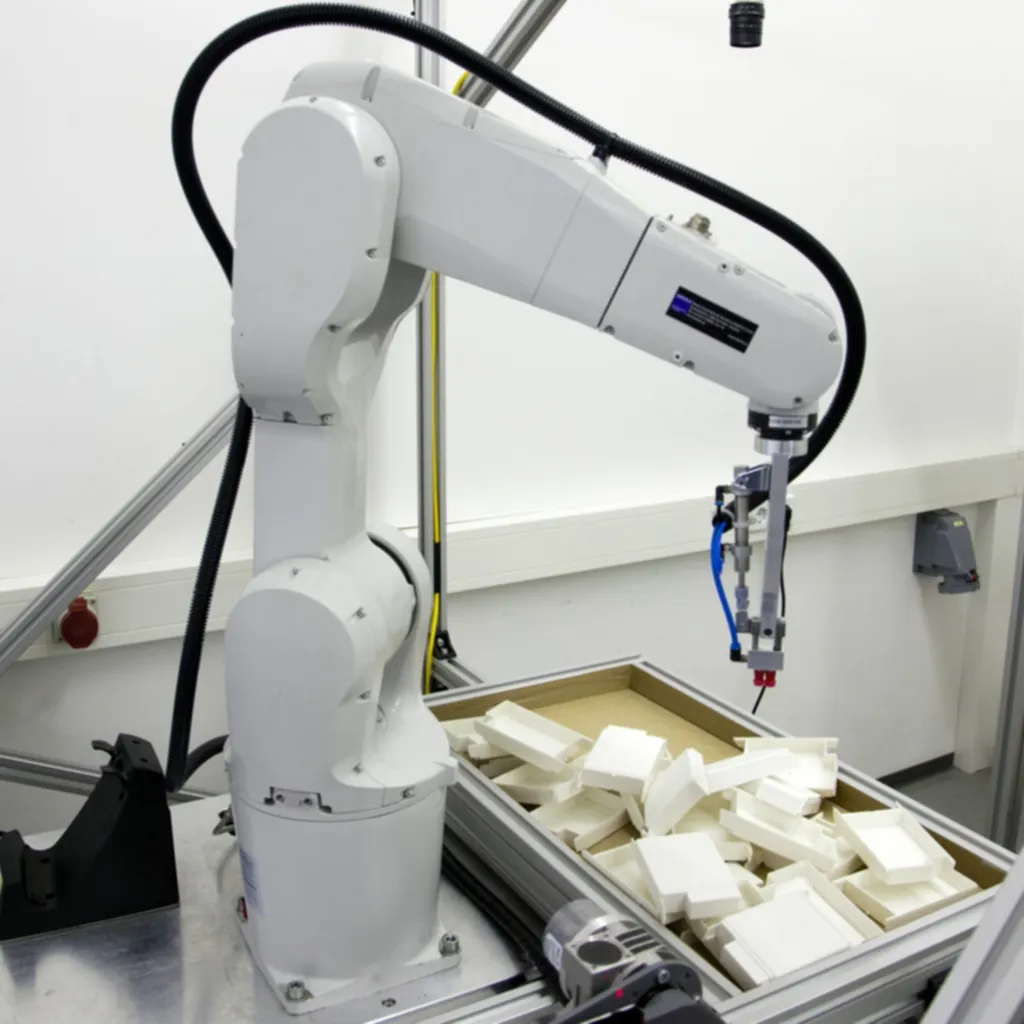
Bin picking and sorting
In bin picking, a high-resolution optical process captures the workpieces in bulk. The position and orientation of each part are passed to the robot, and the path planning module takes the gripping point and interfering edges into account.
- Less effort: the system runs longer without intervention and needs little space.
- Accurate placement: camera measurement places every part exactly.
- Quiet: targeted gripping causes no significant noise.
When sorting, too, the robot uses an integrated camera system to detect the position and identity of workpieces, regardless of how the parts are fed in. This allows machine tools, for example, to be loaded fully automatically. More on camera technology: Industrial image processing.
Playing the video loads it from YouTube (Google), which transmits your IP address. More in our privacy policy. Watch on YouTube
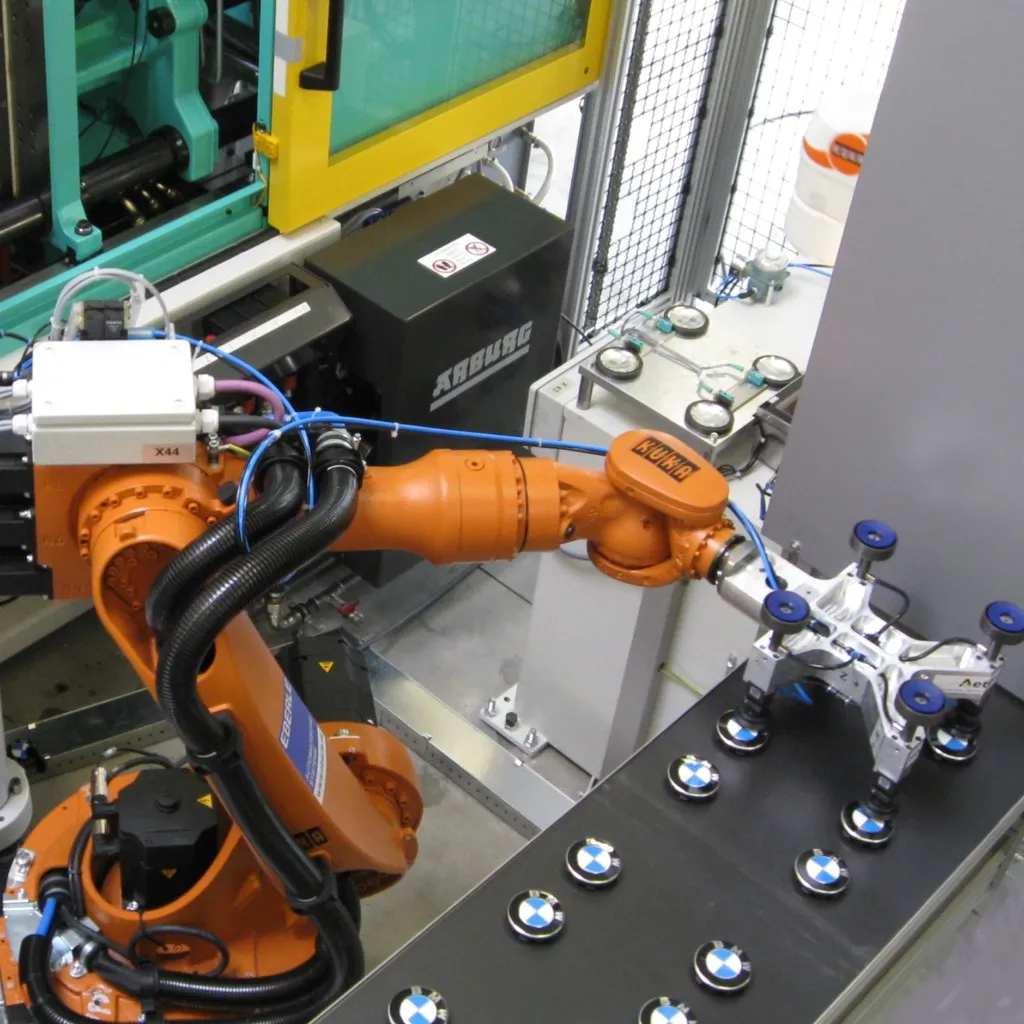
Machine loading
When machines are linked, the robot supplies production machines or conveyors fully automatically.
- Feeding and removing material, in both directions if required.
- Placing parts automatically into transport containers.
- Camera-based production inspection while the containers are filled.
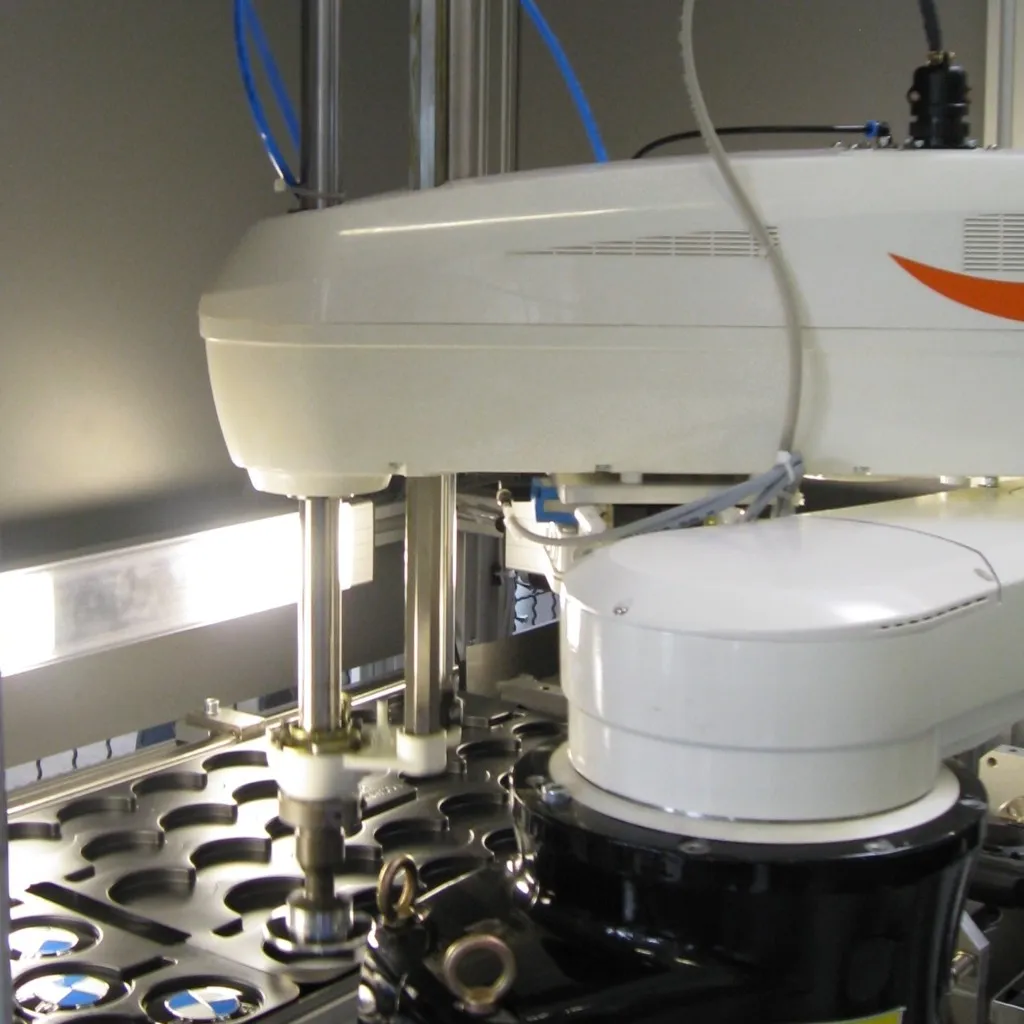
Pick & place
For fast handling of small components, Eberle uses SCARA robots with camera systems. They work precisely and quickly, even in confined spaces.
- High-speed pick & place, precision assembly, material handling and packaging.
- The camera accurately determines the position and orientation of each part.
- Quality inspection of every part in the same step.
| Feature | Value |
|---|---|
| Reach | 600 to 800 mm |
| Camera system | high-resolution, PC-based image processing |
| Data input | from the control computer |
| Lighting | backlighting, integrated into the conveyor |
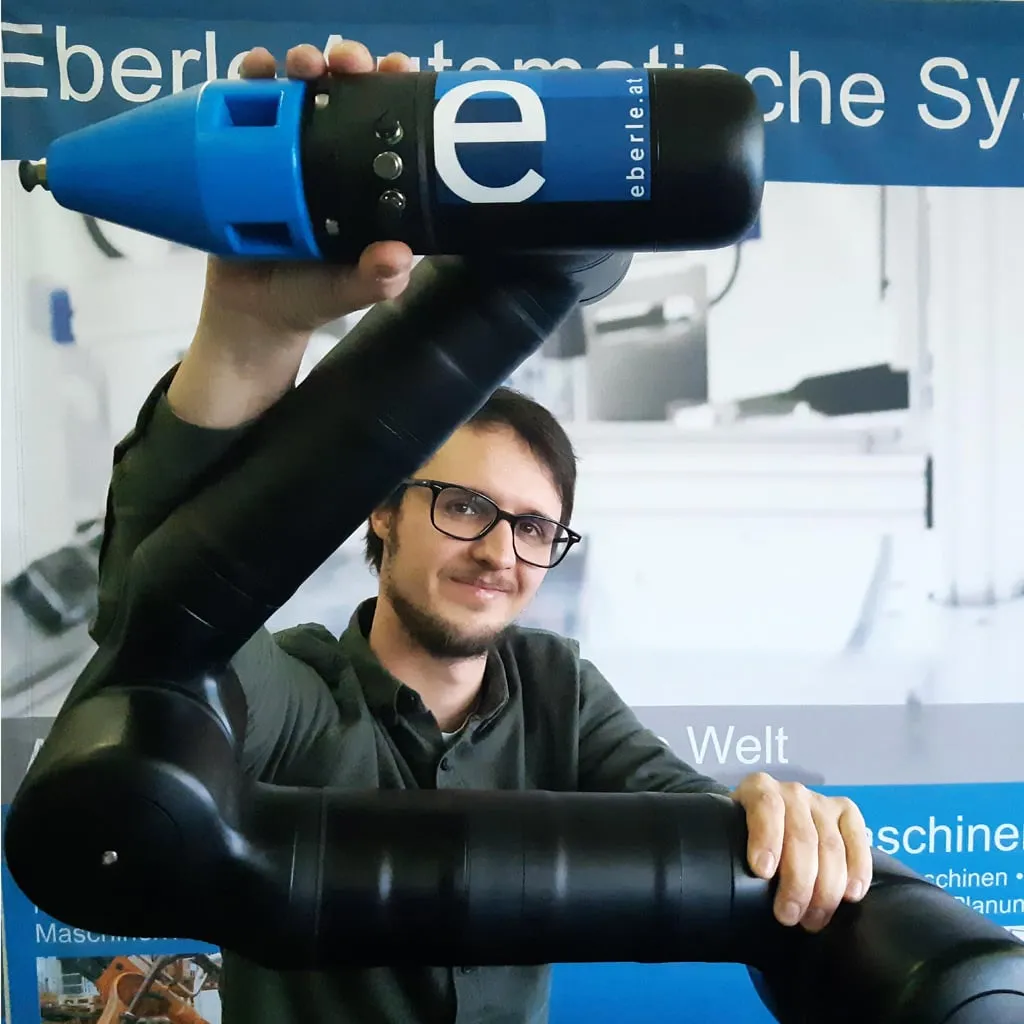
People and robots
Collaborative lightweight robots (cobots) work hand in hand with people and automate repetitive manual tasks.
- No safety fence: a cobot senses contact and does not need a safety enclosure.
- To standard: collaboration is governed by ISO/TS 15066, and the gripper must also be collaborative.
- Checked: as system integrator, we use a risk assessment to check whether the limit values for accidental contact are met.
Transport and partners
For material transport between machines and storage, there are autonomous transport robots such as FTL. For robot solutions, Eberle works with manufacturers such as KUKA and Kassow Robots; more on the Partners page.
Discuss a robot project?
Would you like to solve a task in your production with a robot? Talk to us.