

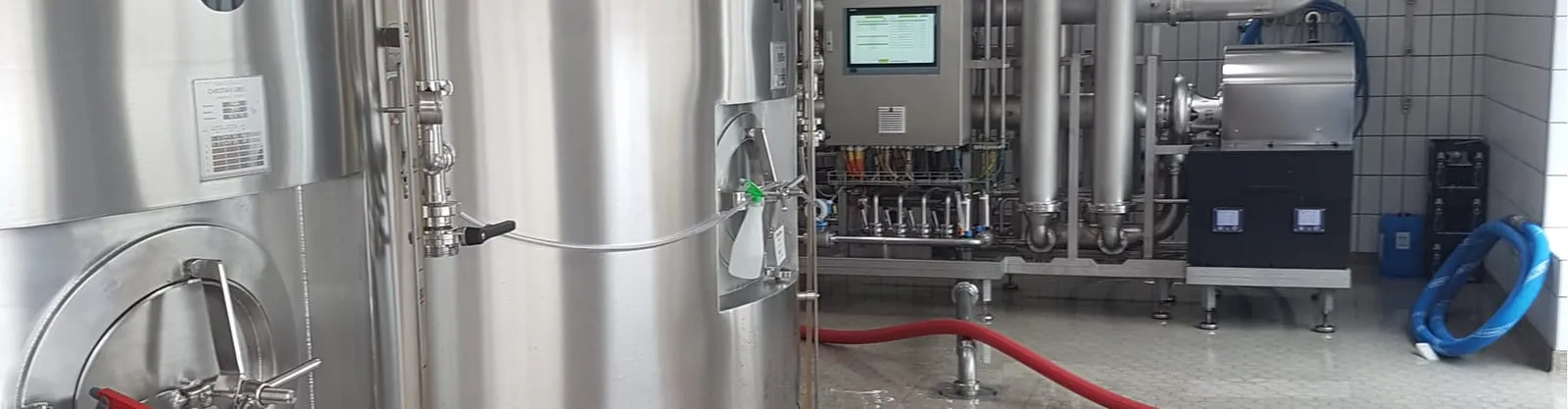
Privatbrauerei Höß GmbH & Co. KG (Der Hirschbräu) in Sonthofen had the control system of its existing CIP plant renewed. Eberle was responsible for the design, programming, conversion and commissioning.
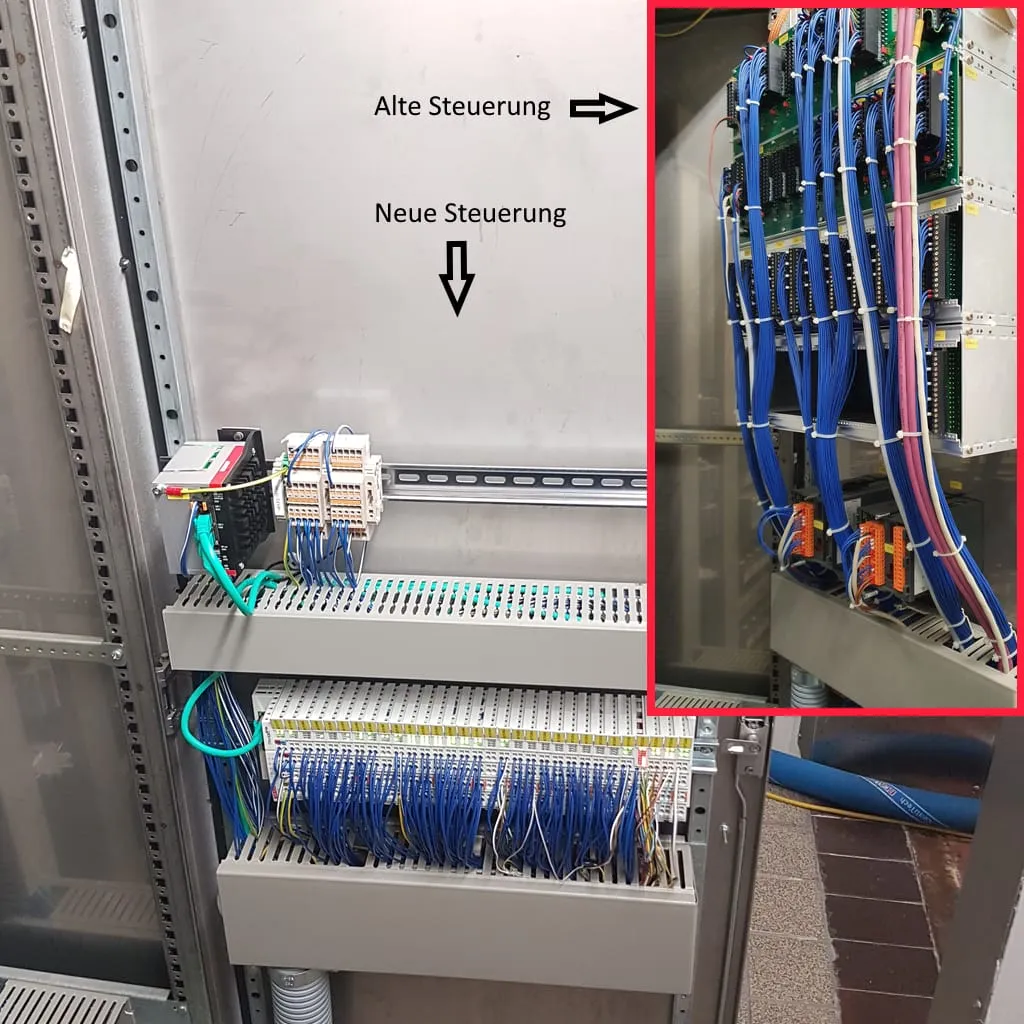
The CIP plant was getting on in years, but the mechanics and pipework were still intact and were to remain. Action was needed on the control system, and the conversion was to take place without a major interruption to operations.
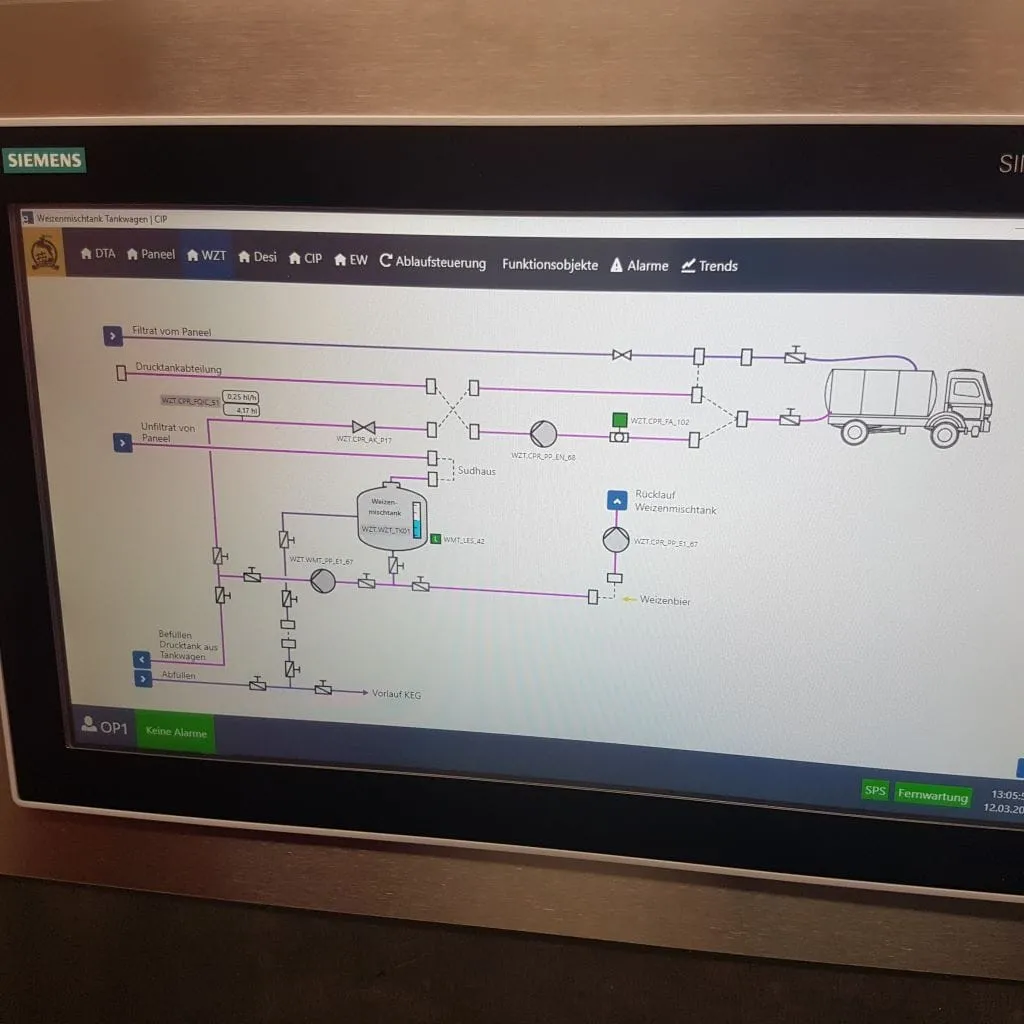
The old controller was replaced by a new PLC-based control system with a web-based user interface, so the brewmaster can also view the plant from his office PC. The existing hardware up to the control cabinet was retained.
We would like to thank Privatbrauerei Höß for their trust, the order and especially for the good cooperation. You will also find the project under projects. What follows is about retrofitting in general: advantages, challenges and procedure.
Why retrofit at all?
There are various reasons for a retrofit, or quite simply necessities. Machines and plants have no expiry date like food, apart from an operating licence that expires by order of the authorities. For technical equipment, machines and plants, other criteria are decisive that call for a new purchase or a retrofit:
- Failures become more frequent and cause more downtime, or a total failure looms.
- Spare parts for the existing machine or plant are no longer available or are difficult to obtain.
- The manufacturers of the replaceable plant components offer no replacement or successor, or the suppliers no longer exist.
- The software used is outdated or can no longer be updated.
- In the event of faults, technicians and service staff have to painstakingly familiarise themselves with the outdated technology or need special tools and software that are no longer available.
- Continued operation in the existing form would mean high production costs due to personnel, energy or reduced production output.
- The plant or machine can no longer keep up with increased requirements or the higher output of upstream processes.
A retrofit is an efficient new start: compared to a new purchase, there are no lengthy evaluation phases and in-depth analyses of different supplier solutions. A new purchase can also involve structural or process-related conversions; with a retrofit, this is usually not necessary or much less extensive. A well-considered retrofit has advantages over a new purchase:
- Experience from operating the old automation is fed specifically into the new automation, better than with standardised new plants.
- Where the application allows, the conversion can be done in stages.
- The mechanics hardly age and continue to be used.
- New control components bring old plants into the networked age of IoT and often solve the interface problem for exchanging data with existing automation systems.
- Service and spare parts supply are secured again.
- A retrofit often goes hand in hand with plant tuning to increase efficiency.
- Reuse or continued use is clearly sustainable.
- The conversion and the retrofit can be planned.
- Less training effort: staff do not need training or further training for new plants.
Whether to retrofit or buy new must be decided case by case. More under mechanical engineering.
The right preparation
Once the decision for a retrofit has been made, it must be prepared accordingly. A retrofit usually means a conversion during ongoing operation or in a production environment – thorough preparation and detailed planning are crucial, much like open-heart surgery. It starts with a detailed inventory: recording all data, reviewing the existing solution and supplementing it with tests and measurements where necessary. Anything that is forgotten or carelessly ignored during the inventory must later be painstakingly incorporated into the implementation planning or execution – or is simply forgotten.
Existing documentation such as circuit diagrams, functional descriptions and programs must be reviewed and understood. Experience with retrofits is an advantage here in order to assess the condition of the machine correctly. The development status of the installed components is recorded in detail so that there is a basis for deciding on the replacement of individual components.
With a retrofit, the plant or machine is brought into line with current normative and legal requirements. The existing safety devices must be checked and supplemented if necessary; for particularly critical applications, a re-evaluation or risk analysis may be required. From a business point of view, it is advisable to keep a preliminary risk assessment up to date with a cost-benefit analysis throughout the design phase.
Digital tools and simulation help to prepare the retrofit and reveal risks at an early stage, before implementation. On the digital twin, for example with twin, processes and programs can be tested virtually. The PLC program of the control system is developed and tested in advance on the digital twin before it is used in the retrofit. Changes are easy to make and try out on the virtual model before they are actually put into practice with the retrofit.
Implementation
Before implementation, the framework conditions for the retrofit must be clear: will the conversion take place during a non-operational period? Will it be carried out in stages? Can updates be reversed if necessary?
As soon as the key data is known, resources and material deliveries are planned and scheduled. The less time is available for the conversion, the more must be invested in planning. Modular hardware and software still make it possible to react flexibly to the unexpected during the conversion phase. The rest is the consistent implementation of the plan. Because the expected behaviour is already known and tested from planning and simulation with the digital twin, the hardware conversion becomes considerably easier, unforeseen risks are reduced and valuable time is saved.
Optimise and connect
A retrofit can and should be accompanied by an optimisation of the existing plant or machine. A retrofit makes it possible, for example, to:
- eliminate existing malfunctions and weak points
- add desired functions
- improve operation and ergonomics
- make the programming flexible and scalable
- save energy, for example with energy-optimised drives
- create modern interfaces for networking
Previous experience from the process can be optimally incorporated into retrofits. This makes retrofits particularly interesting.
Modern automation is networked and offers mobile monitoring
With a retrofit of the control system, the machine or plant is also brought up to date. This makes networked applications, as required by Industry 4.0, easy to implement. Modern controllers offer the necessary data interfaces and, with the connected sensors, record all signals and measured values in the process.
Via an IoT platform such as control, operating and machine data are recorded automatically and do not have to be compiled manually. The data collected and archived make it much easier to trace and analyse processes in machines or plants. Continuous data recording and monitoring make it possible to intervene early in the event of undesirable developments, and data-based maintenance management makes maintenance considerably easier. An IoT platform also makes it easier to monitor machines and plants, and process values can be viewed remotely on mobile devices.
A retrofit makes it possible to design the user interface more clearly, with clear symbols and well-structured assignments. The new user interface can be linked to the digital twin from the planning phase and shows the plant or machine realistically in 3D. This makes operation considerably easier. Web technology is a further simplification: it also enables access to the user interface from a desktop PC at the workplace, for example.
Sustainable through retrofit
A retrofit is inherently more sustainable than a new purchase, because “new” always means that something has to be produced again. Existing and reusable material does not have to be produced again; this eases the burden on the recycling process. Transport costs for a retrofit are much lower. In the overall assessment, however, energy consumption during operation must also be considered: ideally, a retrofit also reduces it, for example through optimised drive components. Modern controllers can better balance energy consumption and the energy supply from the company's own sustainable energy sources, provided this is possible in the process.
After a retrofit, the plant or machine can be operated more economically. An optimally adjusted plant produces more productively, with fewer rejects and better quality. The life cycle is extended, and the original investment in the machine can continue to generate added value long after it has been written off. Factory buildings and machine foundations do not have to be adapted to new plants or machines. This saves money, time, nerves and energy.
How to proceed
If a retrofit is due or desirable for a machine or plant, the procedure must always be tailored to the existing system. However, there are basic steps that must be observed in retrofit projects:
- Check what is defective and what should or can be retained.
- Clarify spare parts supply: what is still available, and for how long does the supplier guarantee it?
- Involve the plant builder or automation engineer early.
- Check economic efficiency: is the plant still producing economically, will more output be needed?
- Plan the conversion: during operation or in scheduled downtime?
- Summarise feasibility and costs as a basis for decisions – the digital twin helps here.