

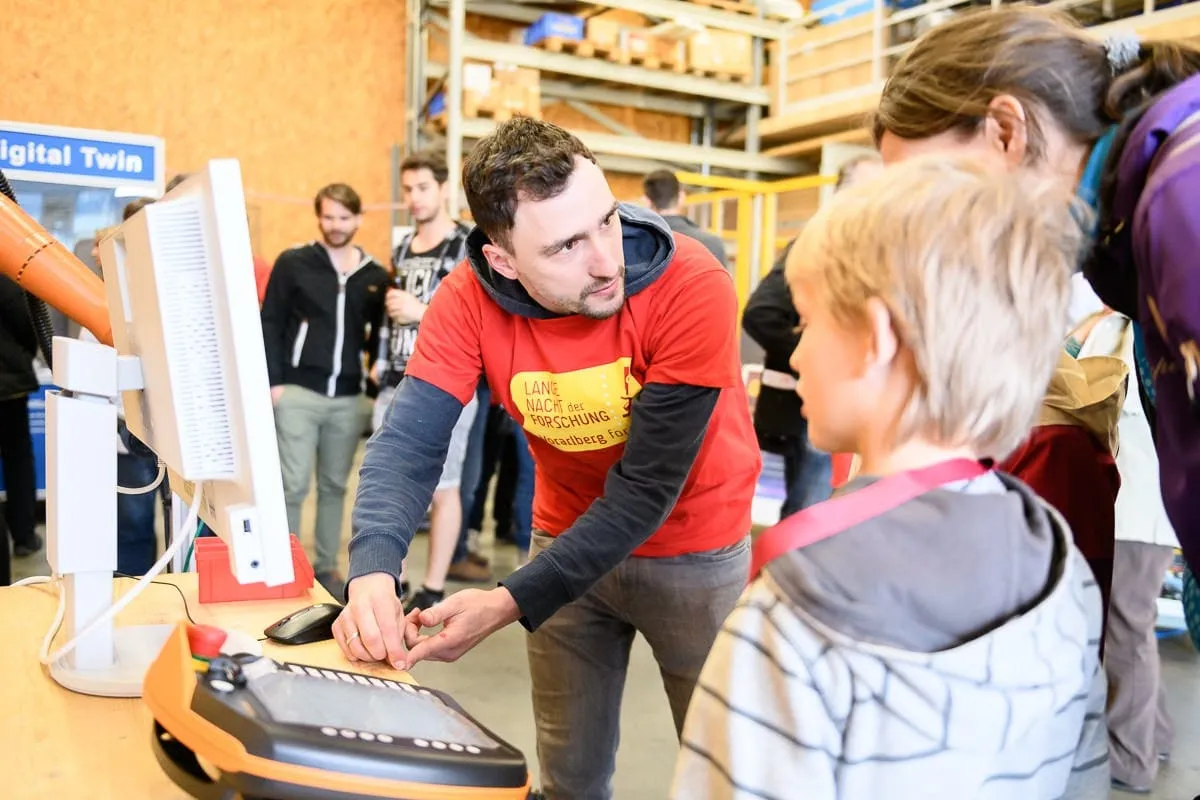
Austria’s biggest science event takes place again on 24 May 2024, and we will be giving an insight into our work. From 5 to 11 p.m., children, young people and adults can discover 118 research stations at ten locations in Dornbirn and Lustenau. The Long Night of Research aims to show what research and science from Vorarlberg can do. With us, you will meet robots as work colleagues, table football opponents, chocolate suppliers and door openers.
Admission is free, and we will be showing everything to do with robotics, digitalisation, automation and technology. Travel by bus and train from all over Vorarlberg is free of charge, and our location can be reached by shuttle bus line 1. All stations and information: langenachtderforschung.at
Photo: © Eva Sutter
- Programme folder of the Long Night of Research 2024
Programme (PDF, German, 4.4 MB)
Our stations
Can artificial intelligence (AI) learn to play table football?
Have you ever played table football? Not so easy. To play well, you need a table, other players and a lot of practice. We ask whether and how an AI can learn this game: what does it need, how can an AI “practise”, and will it end up playing better than a human?
Does the digital ball roll as fast as the real ball?
Can a digital twin not only support industry but also simulate physical processes and show them in an understandable way? You have probably already done some amazing experiments in physics lessons. We try out whether these experiments also work with a digital twin, i.e. a computer simulation.
How do humans and robots talk to each other?
The idea of a collaborative lightweight robot is to work hand in hand with humans. Barriers such as protective devices are no longer necessary. Collaborative robots can therefore perform tasks directly for us or with us. If the robot can be controlled with voice commands, operation becomes simple and intuitive. We show how this is possible.
Is artificial intelligence a door opener?
To think abstractly or draw conclusions, around 85 billion nerve cells, known as neurons, are at work around the clock in our brain – an incredibly complex structure. And this is to be imitated artificially? Not so easy! We show how an artificial intelligence learns to recognise faces and opens doors automatically.
Can cameras count like humans?
Inspecting components in production is monotonous and tiring; it is easy to miscount or overlook something. 100 % inspection is not feasible for humans. This is where industrial image processing comes in, with high speed and recognition rates. Specialised systems recognise, count or precisely measure any object. Can you keep up with the digital eye?
Can your smartphone control our robot?
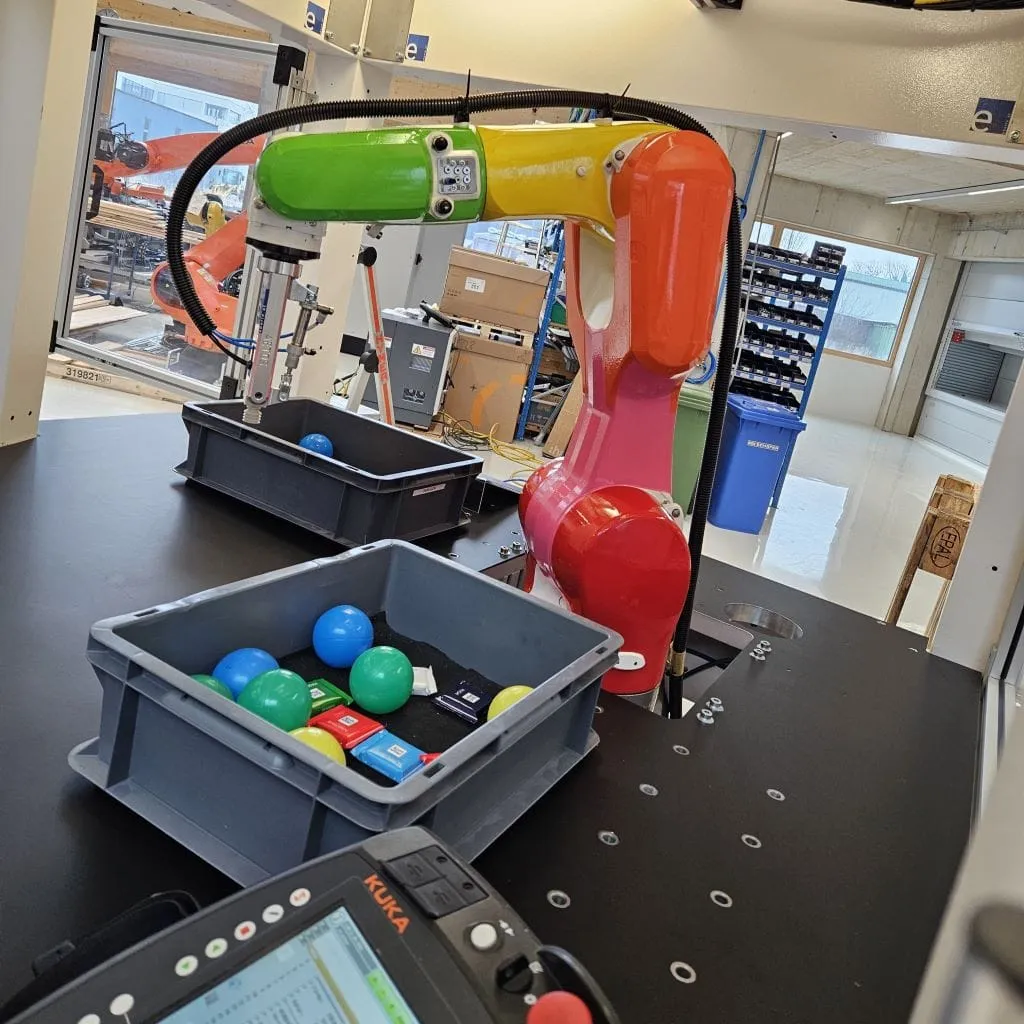
We show how you can get our robot to deliver chocolate to you using your own smartphone. Your order on your smartphone has to find its way to the robot across many systems, virtually “around the world”. Cybersecurity must not be neglected in the process.